Kirkpatricks four levels of evaluation

When we deliver our training course it is vital to use some form of assessment or evaluation as to the effectiveness of our training.  We need to be acutely aware of how well our learners are picking up the core concepts of our training, and on a higher level how well they can then apply these concepts.

Kirkpatrick’s four level of training evaluation was designed for just this situation, it allows you to understand in an objective fashion how effective and impactful your training has been.  This then allows you to self reflect and identify areas of your course that can be improved or developed.

So lets have a look at the four levels and what they mean.

Level 1: Reaction

At this level you are seeking to measure how your learners reacted to the training as it was placed in front of them. A great deal of this comes down to feel, more specifically how did the learner feel about various aspects of the training and process.

This can include how the learner feels about:-

– the training resources.

– the instructor.

– the course (level, topics, objectives, presentation, etc…)


Level 2: Learning

This level seeks to evaluate the learning that has taken place, we are essentially measuring an increase in knowledge or skill.  This essentially comes down to your assessment plan for the course… put even more simply how are you going to judge (and in some cases prove) that the learning objectives have been met.


Level 3: Behaviours (Transfer)

This is a higher level of learning, where as many objectives are about recall, of a fact or a method of doing a certain task.  This is all about the application of knowledge, has your training truly made a change in the learner, has it been taken on as part of their approach.  This application goes much deeper than sheer recall.

Now for behaviour change to take place we need to ensure that we cultivate an environment where change is possible, this is an area that is not often considered by course designers.  The environment is so important when it comes to the ability of learners to go through the behaviour change process…. this is probably a topic for a post of its own.

It is important to note that there are such a wide range of reasons as to why learning has not been applied, so just because this level of evaluation is not positive does not equate to a lack of a learning process.

Level 4: Results

What has been the overall result of your training programme in a wider context.  Does the training provided meet wider organisational or industry needs?

Evaluation is such an important process within education, we have to bear in mind that just ‘because this is how it has always been done’ or ‘it would be alot of work to change that’… in my opinion anyway is not a reason not to give our learners the very best we can in terms of education.  They deserve it and as educators we can always and should always be looking for ways to push our own and in turn our learners boundaries.
So here is a question for you do you evaluate your training on all levels?  Or does it tend to be assessment based (level 2) and feedback based (level 1)?  How could you identify behaviour and results based changes?
What can you improve today about your courses? Share with us what you have found in terms of evaluation, just use the comments box below.

About the Author

tom_cropped_400x400Tom Godwin  (@TomForesight) has been involved in the fitness industry for nearly 20 years.  He is a specialist in exercise referral, corrective exercise and helping other personal trainers improve their business.  He is involved with personal trainer education as a tutor, assessor, IQA and course developer. Http://www.TomGodwin.co.uk
The ADDIE Model of Instructional Design

I have been involved in the creation and design of courses for the fitness and personal training industry for some time.  When I first started developing courses I was blissfully unaware of the vast subject area that is instructional design.  Since finding this subject i have learnt a great deal about how courses can be put together in a manner that will lead to the optimal learning experience for our learners.

Over the next few posts in the fitness educator area of my site I am going to examine some of the key concepts in the area of instructional design for the fitness industry.  The first model that I have decided to look at is the ADDIE model of instructional design.  I am a big one for processes, having an established process to follow for given situations can help to streamline and focus your efforts.  The ADDIE model is an established instructional design model that helps to guide through five stages of instructional design.  The five phases being Analysis, Design, Development, Implementation, and Evaluation.  These represent a  guideline for building effective training and support tools, these five stages have been discussed below:-

Analysis Phase

During this phase the instructional problem is clarified.  This then leads to the development of a goal and establishment of the learning objectives.  There are a number of key questions that need to be addressed in this stage:-

– Who are the learners, what do you know about them?

– Are there any constraints or barriers to learning?

– What options do you have in terms of delivery?

– What timeframe and budget do you have available to you?


Design Phase

This phase is where you start to set learning objectives, assessment plans/criteria, design schemes of work, lesson plans and resources.  There should be a logical approach taken to design, with a system of review and editing to ensure that courses are fit for purpose.  Many designers will use a storyboard or learner journey approach to instructional design, this should lead to the development of a course that is ready for first delivery in a prototype type stage.


Development Phase

This stage sees a larger range of people becoming involved in the process with often the need for involvement from programmers, graphic designers and web developers.  This is where the prototype comes together into a more polished final product.  Effectively what is being developed here is a prototype course that can can into first delivery and from there go into a cycle of development and improvement.

Implementation Phase

This stage starts off with first delivery, it is suggested that initially internal candidates and technical experts work through the course.  This will have the initial benefit of allowing the identification of any initial mistakes or improvements before real life students take part.  This is effective the dry run phase.

The next stage is the initial delivery of the course to real learners, this stage is one where it is important not to take your eye off the ball. It is important that how the learners react and their views, problems and any comments are considered and where needed addressed.


Evaluation Phase

This stage is the on-going where a feedback loop should be implemented with regular feedback being gained from learners and tutors/assessors, this should then be fed into the instructional designers who then consider comments and make changes are updates to the course as needed.

This model is a very basic instructional design model and there have been a number of additions, re-works and updates to the ADDIE system.  If you are new to considering the instructional design process this is a great place to start.  We can make it more complicated as we go on!


If you have used the ADDIE system before or have any comments please do share them below!

About the Author

tom_cropped_400x400Tom Godwin  (@TomForesight) has been involved in the fitness industry for nearly 20 years.  He is a specialist in exercise referral, corrective exercise and helping other personal trainers improve their business.  He is involved with personal trainer education as a tutor, assessor, IQA and course developer. Http://www.TomGodwin.co.uk

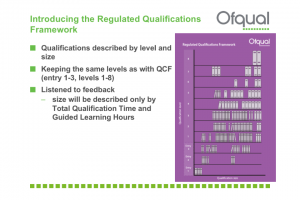
What is the Regulated Qualification Framework?

Over the last few months I have been talking to a fair few people involved in fitness education with regard to the new Regulated Qualifications Framework (RQF).  There has been much discussion of how this will effect those involved in fitness and health education.

Regulated Qualification Framework

The RQF will be introduced on 1 October 2015 and replaces the the outgoing Qualification, so is well in place by now.  There however seems to be a great deal of confusion over what the new system will mean for training providers and ultimately learners.

The idea as expressed by Jeremy Benson, Executive Director of Vocational Qualifications, is that the RQF will provide a single, simple system for cataloguing all qualifications regulated by Ofqual.   There are a number of key documents that have been made available by Ofqual to help those involved in education gain a greater insight into how the RQF will effect them!

I would start by looking at this video though where Ofqual explains the basics of how the RQF system will work.

There have also been some key documents that have been released over the last few months that give a little more detail about key aspects of the RQF.  I have enclosed a short run down of each of these documents below:-

Qualifications and Components – this document outlines the requirements for different levels of qualification, including the level descriptors.

Total Qualification Time – This details the guidance around the assignment of total learning hours and guided learning hours.  This may make some interesting reading for providers of distance learning and minimal contact courses.

After the QCF – a collection of documents that show the process of establishing and researching the RQF.

The general conditions of recognition and the supplement to that document are also available.

These documents in general are not light reading but they do help to explain the major differences when it come to the RQF and how it difference for the QCF.

About the Author

tom_cropped_400x400Tom Godwin  (@TomForesight) has been involved in the fitness industry for nearly 20 years.  He is a specialist in exercise referral, corrective exercise and helping other personal trainers improve their business.  He is involved with personal trainer education as a tutor, assessor, IQA and course developer. Http://www.TomGodwin.co.uk

Innovation in Fitness Education

Innovation is an interesting concept by definition it is related to the introduction of new ideas, concepts or methods of working.  We are at an exciting time within education with many new tools and resources allowing us to bring our message to learners in new ways.

Within the fitness industry innovation is seen all around us with massive leaps being made in the use of new media and technology to deliver fitness as a product in new ways.  With an increasing number of services being taken digital or on-line.

The education of our fitness professionals is no different, we have seen a drastic increase in the numbers of learners who wish to study remotely.  This has a number of key benefits for learners in that they do not have to travel to attend courses, they can study around other commitments and these courses are inevitably cheaper.  This in turn has initiated a flurry of training companies that are seeking to cater for this demand.

The morality and effectiveness of distance learning in such a practically grounded industry has been keen area of discussion amongst those within those involved in fitness education.  With some believing that fitness as a subject should be wholly delivered within a classroom.  Where as others have embraced new technology and media and recognise how this may be used in the modern world of education.

It is not as clear cut as this subject is practical so it should be delivered in a practical way.  Where as another subject is more theory based therefore it is more acceptable for online delivery.  Really the design of courses should take into account what is the best learning tool to get a given concept across to the learners. In some cases you can not beat being face to face learning with an experienced instructor.  In other cases this is not so important and the consideration of how technology might be used should be considered.

The use of e.learning is nothing new with it being used extensively in many industries for a number of years.  Personally I remember my first e.learning course and it was pretty much a single .pdf document, really the only e part of it was that the document was e-mailed.  Thankfully we have taken leaps and bounds from this point with some of the learning I have been involved with developing including much more interactive elements that cater for a wide range of learning styles.

The use of podcasts, video lectures (both live and pre recorded), forums, chat rooms, social platforms, quizzes, and gameification are all things that I have used and do advocate.  It is of vital importance that training providers and their course developers understand that although many of the above approaches may look flash and represent a cost saving to the training provider…  They are merely tools for the job, the skill and in my book innovation lies in weaving these methods together to create exciting and most of all engaging learning opportunities which build up to create fully rounded and educated fitness professionals.

About the Author

tom_cropped_400x400Tom Godwin  (@TomForesight) has been involved in the fitness industry for nearly 20 years.  He is a specialist in exercise referral, corrective exercise and helping other personal trainers improve their business.  He is involved with personal trainer education as a tutor, assessor, IQA and course developer.  Http://www.TomGodwin.co.uk